How it will work
How a sale will work
Five steps and one record. This is the process the company is being built to run. Each step depends on a licence or registration listed on the Updates page.
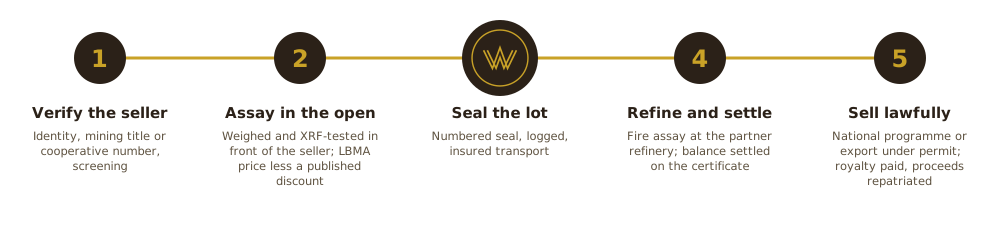
Verify the seller
Identity, and a mining title or cooperative registration checked with the Nigerian Mining Cadastre Office. Sanctions and PEP screening (checks for politically exposed persons). No file, no purchase.
Assay in the open
The lot is weighed and tested with an XRF analyser (X-ray fluorescence, a test that reads purity in seconds) in front of the seller. The price is the LBMA Gold Price on the day less a discount we will publish before the first purchase. An advance is paid by bank transfer the same day.
Seal the lot

A numbered seal that shows if it has been opened. The lot is logged and moved under specie insurance (cover for precious metal in transit), to be placed before the first lot. The seal number will follow the metal through every handover.
Refine and settle
Fire assay (the refinery's melt test) at a partner refinery, in Nigeria or abroad under an export permit obtained before shipment, fixes final weight and purity. The balance is paid by transfer within an agreed number of days of the certificate, and the seller sees the certificate.
Sell lawfully
The refined gold is sold to the National Gold Purchase Programme or to a lawful buyer abroad under permit. Royalty is paid, and export proceeds are repatriated through an authorised dealer bank within the period the Central Bank of Nigeria prescribes.
All payments to sellers will be made by bank transfer, never in cash. The Money Laundering (Prevention and Prohibition) Act 2022 requires cash above ₦5,000,000 for individuals or ₦10,000,000 for companies to pass through a bank. We go further and pay nothing in cash.
What assaying is
Assaying is testing a sample of metal to find how pure it is. Raw gold from a mine, called doré, is never pure. A kilogram might be 70 percent gold or 90 percent, and the price both ways depends on that figure. XRF reads the composition in seconds without damaging the sample and sets the provisional price. Fire assay melts a small sample and weighs the gold recovered. It is slower but exact, and it fixes the final price.
Why the seal matters
The gap between the field assay and the refinery assay is where disputes happen. A numbered seal applied in front of the seller, and logged at every handover, proves nothing was swapped between the buying centre and the refinery. If the two assays differ, the refinery certificate decides, and the seller sees it.